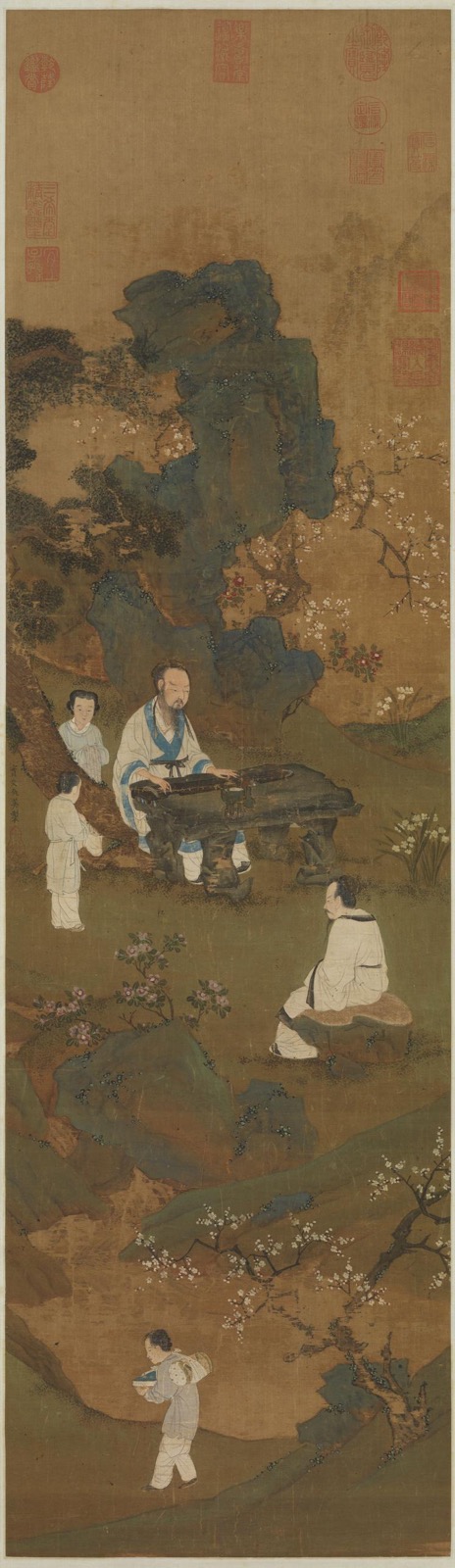
Guqin Culture
Guqin is our starting point. A phrase of music, a historical score or a shared study session can open a path into cultural practice and research.
The Scholar's Instrument
The guqin (seven-stringed zither) stands first among the four arts of the scholar — qin, chess, calligraphy, and painting — an instrument for cultivating the self. For centuries, literati turned to the qin for reflection and for friendship; what its sound carries is a person's temperament and aspiration.
A gentleman does not part with his qin and se without good reason.
—— Book of Rites, “Qu Li”
The qin was a daily companion in self-cultivation, rarely set aside — as this old maxim makes plain.
Origins and Form
The form of the qin evolved over a long span, maturing by the Han and Wei dynasties; the seven-string design settled then has been used ever since, making it one of the oldest surviving musical traditions in China. The Book of Songs already sings of “the graceful maiden, befriended with qin and se”; a stringed instrument unearthed from the Warring States tomb of Marquis Yi of Zeng attests to the tradition's deep origins.
Passing Down the Music
That music a thousand years old still sounds today owes to a distinctive system of notation. From early longhand tablature detailing each fingering, to the abbreviated tablature simplified by Cao Rou in the late Tang, qin players passed scores hand to hand, letting old pieces be heard again string by string. The earliest surviving score is “Jieshi Diao: You Lan,” copied by a Tang hand from Qiu Ming of the Southern Liang; the earliest surviving anthology is the “Shen Qi Mi Pu,” compiled by Zhu Quan of the Ming in 1425.
The Aesthetic of the Qin
The qin's aesthetic prizes restraint and a lingering resonance. In the Ming, Xu Shangying's “Xishan Qin Kuang” discussed the qin through twenty-four moods; the phrase “centered and calm, clear and far” captures its essence. This sensibility joins the Confucian ideal of balanced self-cultivation, the Daoist return to nature, and the Chan taste for quiet contemplation — each nourishing, together forming the depth of the qin's way.
A Tradition Still Growing
The art of the guqin was proclaimed a UNESCO Masterpiece of the Oral and Intangible Heritage of Humanity in 2003 and inscribed on the Representative List of the Intangible Cultural Heritage of Humanity in 2008. Its living tradition continues through listening, study and gathering.
From practice to research
Gui Gu's research interests include Guqin × AI, music technology, cultural corpora and multimodal cultural heritage preservation. We seek to bring practitioners and researchers together to explore how guqin can be studied, preserved, learned and shared in the age of AI.